Skip to content

Our Sire Proving Scheme produces many of New Zealand’s best bulls.
Each year, a group of genetically elite young dairy bull calves join our Sire Proving Scheme (SPS), the very best of which will progress to join our premium artificial insemination teams after a period of evaluation and testing.
We use a combination of ancestry records, DNA testing, and traditional daughter proving to identify the bulls that will bring the most genetic value to your herd.
The scheme has an impressive track record with bespoke breeding programmes for three dairy products: Holstein-Friesian, Jersey and KiwiCross®. It has increased the productivity of New Zealand’s dairy cows and contributed billions to the national economy since it was set up in 1961.
Graduates from the scheme you will find within our Bull Tool with detailed genomic evaluation data.
How LIC’s Sire Proving Scheme Works
Our Sire Proving Scheme is a four-year programme to find the best daughter proven bulls for our national and international customers. Importantly, it also provides valuable genotype and phenotype data that improves the accuracy of the genomic evaluation model, strengthening our genomic product offering. The SPS scheme is a key source of phenotypic data on non-production traits such as conformation and workability.
Choosing male calves to join the scheme
LIC works closely with our bull breeder farmers to breed bulls from elite cow families. We screen the national herd for other outstanding potential dams and receive additional offers of other bulls bred from our national milking herd of almost 5 million cows.
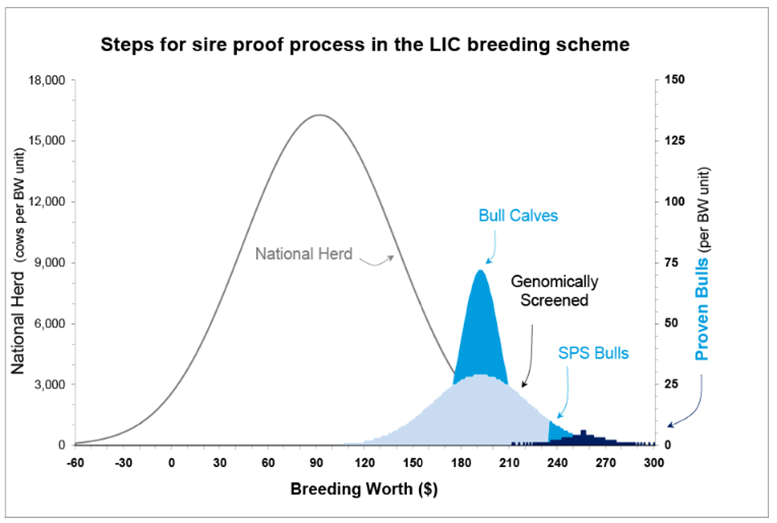
Each year we screen a number of elite bull calves, using genomic testing to select those with the most desirable genetic traits including the production efficiency and robustness traits in BW, and other conformation and management traits important to farmers.
These bull calves then join the Sire Proving Scheme and spend the next four years grazing on our bull farms.
Selecting farmers to participate in the scheme
Daughters of sire proving scheme herds are tested in high-performing herds that are representative of the New Zealand dairy industry across geographical locations and farm systems. Each year top dairy farmers have a chance to join the scheme, which has about 95,000 cows producing 20,000 daughters.
Participating farms must:
- have a stable herd size between 200 – 850 cows
- participate for four years
- mate 90% of their herd to SPS bulls
- commit to spring block calving
- record any defects
- record daughter trait comments
- have four milk recording events a year
- present the bull daughters for inspection by independent assessors
- record farmer assessed trait scores
- keep full and accurate records
Inseminating cows on participating farms
When the bulls are about one year old their semen is used across cows in the Sire Proving Scheme herds. The resulting daughters are parentage verified to sire to ensure accuracy in their sires’ evaluations.
Calving the daughters and measuring their performance
Daughters are mated as yearlings to calve down into herds as two-year-olds. Once they have calved and start milking, we measure their productivity through regular milk recording.
We also collect other information during their first lactation, including:
- management and conformation traits (Traits Other than Production -TOP)
- live weight and body condition score
- calving difficulty scores for all calvings
- fertility performance measures (calving and mating information)
- culls and losses
Getting proofs for the bulls
Bull proofs use information from their daughters’ lactations, comparing their daughters’ performance within their contemporary group in each herd. We use the proofs to identify the most genetically elite bulls; bulls whose daughters consistently rank at the top end of their group across many herds. These bulls graduate to join our artificial insemination teams as a daughter proven sire.
But it doesn’t stop there, we continue to monitor the bulls’ performance after their initial proof by capturing information through their daughters’ lives.
This is especially important for later expressed traits such as fertility and survival, which take longer to be fully expressed. Information on the Female Fertility trait (Calving Rate in 42 days) and the separate trait of Survival (from each lactation to the next) contributes to genetic estimates for many years.
For these traits, the contribution of genomic estimations in our LIC Genomic Evaluation model improves the reliability of early estimates while ongoing daughter information flows in.
He’s graduated!
Approximately 10% of the original genomically selected sires graduate to the market as fully daughter proven sires, and just over 1% of the original bulls calves screened. That’s some selection pressure!
Farmers can have confidence that a LIC daughter-proven bull really is the cream of the crop, with plenty of daughter evidence sitting behind him!